AI Search Visibility: The Practical Guide to Generative Engine Optimization (GEO)
Generative Engine Optimization (GEO) is the practice of making your brand visible in AI search answers from ChatGPT, Google AI, and Perplexity. Learn what GEO is, how it differs from SEO, and specific strategies to improve your AI brand visibility.
Generative Engine Optimization (GEO) is the practice of making your brand visible in AI-generated search answers from ChatGPT, Google AI, Perplexity, and similar platforms. Unlike traditional SEO where you compete for ranking position, GEO is about competing for inclusion in the answer itself. This guide covers what GEO is, why it matters, and specific actions to improve your AI visibility — from quick technical wins to mid-term brand-building strategies.
The Invisible Shift

93% of AI search sessions end without a single click to a website. That’s not a prediction — it’s what’s happening right now, across hundreds of millions of daily interactions with ChatGPT, Google AI, Perplexity, and other AI assistants.
The scale is hard to overstate. Over 810 million people use ChatGPT daily. Google AI Overviews reach 1.5 billion monthly users. 75% of people say they use AI search more than they did a year ago, and 43% use it daily. Gartner projects that by 2028, half of all online searches will involve an AI assistant — while traditional search volume is expected to drop 25% as early as this year.
Here’s what makes this shift different from anything before: AI doesn’t give you a list of links. It gives you an answer — a curated, opinionated-sounding recommendation. If your brand isn’t part of that answer, you’re not second on the page. You simply don’t exist. And the window is volatile: only 30% of brands that appear in one AI answer show up again in the next.
The counterintuitive upside? The visitors who do come through AI convert at 2–4x the rate of traditional organic search. This isn’t just a traffic problem — it’s an AI brand visibility problem with direct revenue impact.
This is what Generative Engine Optimization — GEO — is about: making sure AI recommends your brand when it matters. This guide covers what GEO is, how it differs from SEO, and exactly what you can do about it — from quick wins this week to long-term strategic plays.
1. What Is GEO? (And How It Compares to SEO)
Defining GEO
Generative Engine Optimization — sometimes called AI search optimization — is the practice of improving your brand’s chances of being surfaced, mentioned, or recommended in AI-generated responses — across platforms like ChatGPT, Google AI Overviews, Google AI Mode, Perplexity, Claude, and Gemini.
The term was formalized in a 2023 research paper by a team from Princeton, Georgia Tech, and IIT Delhi, later accepted at KDD 2024 — one of the most prestigious conferences in data science. The researchers defined “generative engines” as search systems that synthesize information from multiple sources and deliver AI-generated answers rather than lists of links. Their experiments demonstrated that applying GEO techniques could boost content visibility in these AI responses by up to 40%.
What made their work particularly important was the finding that the effectiveness of different optimization strategies varies significantly across domains. What works for healthcare content doesn’t necessarily work for e-commerce. GEO, unlike early SEO, wasn’t born in a garage — it was born in a research lab, with benchmarks and measurement frameworks (GEO-bench) built in from day one.
The shift: from ranking to inclusion
To understand GEO, it helps to contrast it with what came before.
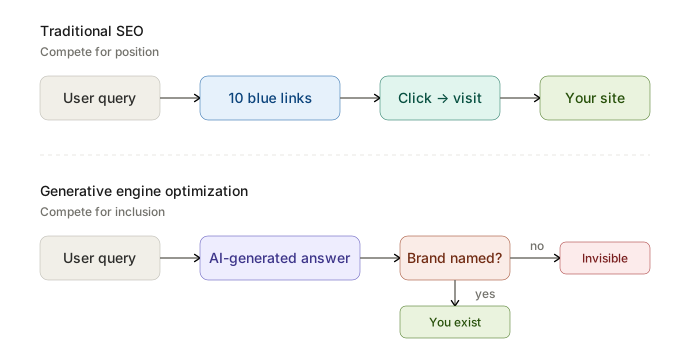
In traditional SEO, the game was clear: optimize your pages so they rank higher in a list of ten blue links. The user would scan the results, click on the most relevant one, and visit your site. Your job was to win a position — preferably in the top three results, where the vast majority of clicks concentrated.
GEO plays a fundamentally different game. When someone asks ChatGPT “what’s the best project management tool for a remote team?” or types a similar query into Google AI Mode, the AI doesn’t return a list of links. It synthesizes information from its training data, the web, and its retrieval systems to produce a single, coherent answer. That answer might mention three to five brands, provide a brief rationale for each, and sometimes cite sources — but often it doesn’t. The user reads the answer, picks a direction, and may never click a single link.
This means the competitive unit has changed. In SEO, you competed for position. In GEO, you compete for inclusion. Either the AI mentions your brand, or it doesn’t. There is no “page two” — there is only the answer.
What’s different, concretely
Several distinctions make GEO a genuinely different discipline, not just a rebranding of SEO practices.
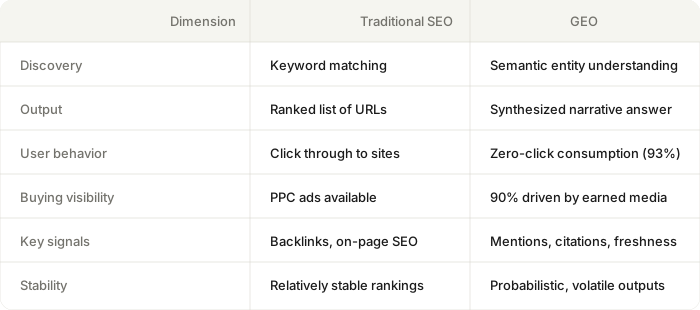
Discovery is semantic, not keyword-based. Traditional search engines matched queries to documents via keywords and links. Generative engines understand intent, context, and entities. They don’t look for pages that contain the phrase “best CRM for startups” — they look for brands and products they’ve learned to associate with that concept, from training data, web sources, reviews, and community discussions.
Outputs are narrative, not lists. AI responses read like recommendations from a knowledgeable colleague. As Edelman’s AI team has observed, LLM responses don’t just list options — they sound opinionated and authoritative. This raises the stakes enormously: if the AI says something inaccurate or outdated about your brand, it comes across as a credible expert opinion, not a random search result.
Visibility can’t be bought. There is no Google Ads equivalent for most AI platforms (yet). According to Edelman, up to 90% of citations that drive brand visibility in LLM responses come from earned media — articles, reviews, mentions, and community discussions. This makes GEO fundamentally more dependent on genuine brand authority and far less susceptible to pay-for-play tactics.
Results are probabilistic, not deterministic. Ask Google the same query ten times and you’ll get essentially the same results. Ask ChatGPT the same question 100 times and — as research by SparkToro demonstrated — you’ll get a different list of brands nearly every time. There’s less than a 1-in-100 chance of receiving the same brand list in any two responses. The order is even more random — closer to 1 in 1,000 runs before you’d see two lists in the same sequence. These systems are probability engines, not lookup tables, and that has profound implications for how we measure visibility (more on this later).
Off-site signals dominate. A large-scale study of 75,000 brands found that YouTube mentions show the strongest correlation with AI visibility — stronger than any on-site metric. Branded web mentions across third-party sites ranked second. Meanwhile, the number of pages on your site and raw backlink volume showed almost no relationship with AI visibility. In other words, what others say about you matters far more than what you say about yourself.
Now — what GEO strategies actually work?
2. How to Improve Your AI Brand Visibility
Low-hanging fruits (this week)
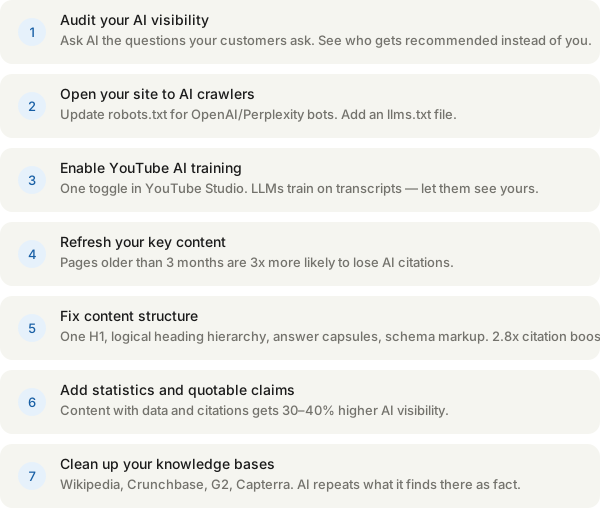
Audit your current AI visibility. Before optimizing anything, find out where you stand. Ask ChatGPT, Gemini, Perplexity, and Claude the questions your customers ask — and see who gets recommended. Do this across platforms: the same brand can see citation volumes differ by hundreds of times depending on which AI you query. Tools like ChatBenchmark can automate this by tracking your share of voice across AI models, showing which competitors appear instead of you, and identifying which sources LLMs cite in your category. This is the essential first step if you want to understand how to rank in ChatGPT and other AI platforms.
Open your site to AI crawlers. If AI can’t crawl your site, it can’t cite your content. Update your robots.txt to explicitly allow bots from OpenAI, Perplexity, and other LLM providers. Consider adding an llms.txt file — a plain-text description of your site, its structure, and key pages, designed specifically to help language models understand what you offer. This is a one-time technical task with near-zero effort.
Enable AI training on your YouTube channel. In YouTube Studio, under Settings → Channel → Advanced settings, there’s a toggle that allows third-party companies to train AI models on your video transcripts. One click. LLMs heavily rely on YouTube as a structured, trusted content source — enabling this setting has been observed to produce noticeable jumps in AI visibility, particularly in Gemini — one of the simplest ways to optimize for AI search.
Refresh your most important content. Pages not updated within three months are over 3x more likely to lose AI citations. More than 70% of all pages cited by AI were updated within the past 12 months — and for commercial queries, that number rises to 83%. Start with your pricing pages, product comparisons, and key blog posts. Add current data, update publication dates visibly.
Fix your content structure. Pages with sequential heading hierarchies are cited 2.8x more often than those with fragmented structure. 87% of pages cited by ChatGPT use a single H1 tag. Audit your top pages: one H1, logical H2/H3 hierarchy, no skipped levels. Add structured data where it fits — FAQ schema, Organization schema, HowTo markup. One technique worth adopting: place a concise, self-contained answer near the top of each page — a short block that directly answers the question the page addresses. These “answer capsules” are one of the most common features of content cited by AI models.
Add statistics and quotable claims. The original GEO research (Aggarwal et al.) found that content enriched with statistics, citations, and expert quotations achieves 30–40% higher visibility in AI responses. LLMs prefer content they can extract clean, attributable facts from. Go through your key pages and add specific numbers, data points, and clearly sourced claims.
Claim and clean up your knowledge bases. Ensure your Wikipedia entry, Wikidata, Crunchbase, G2/Capterra profiles, and industry directory listings are accurate and current. These are among the most-cited domains in LLM responses. Fix anything outdated, incorrect, or negative — AI will repeat it as if it were fact.
Mid-term GEO strategies (1–3 months)
Build an earned media and digital PR strategy. According to Edelman, up to 90% of citations driving brand visibility in LLMs come from earned media. Research shows that 85% of brand mentions in AI originate from third-party pages, not owned domains. Target industry publications, review sites, expert roundups, and authoritative blogs. The goal: become a cited source, not just a mentioned name. Provide original data, contribute expert opinions, publish joint research.
Invest in YouTube presence. A study of 75,000 brands found YouTube mentions to be the single strongest correlate of AI visibility across all platforms (~0.737) — outperforming every other factor tested. Both Google and OpenAI trained their models on YouTube transcripts, so this isn’t just a Google effect. Importantly, the volume of mentions matters more than reach: being mentioned across many videos — even low-view ones — is more valuable than a single viral hit. Create content, get featured in reviews, participate in expert interviews, sponsor relevant channels.
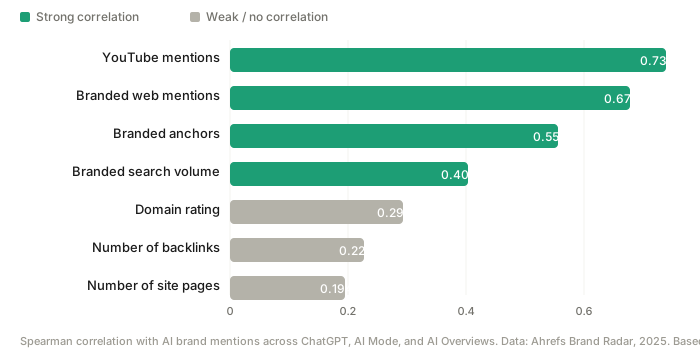
Pursue third-party mentions and community presence. Branded web mentions across third-party sites are the second strongest correlate of AI visibility (0.66–0.71). Nearly half of AI citations come from community platforms like Reddit and YouTube. Participate authentically in relevant subreddits, Quora threads, GitHub discussions, and industry forums. Seek reviews on G2, Capterra, Trustpilot. Guest post, get quoted, join podcasts.
Create content designed for AI citability. Publish original research — surveys, benchmarks, industry reports. LLMs heavily favor content they can cite as a source of original data. Create definitive guides in your niche, keep them updated, and address comparison queries (“X vs Y,” “best tools for Z”) — these are the high-intent prompts where AI has to name brands. A word of caution: publishing more pages doesn’t help. The correlation between site page count and AI visibility is nearly zero (~0.194). Focus on quality and citability, not volume.
Set up multi-platform monitoring. AI visibility is volatile — declines of 36% in five weeks have been documented. And different platforms behave differently: ChatGPT and Google AI Mode diverge significantly in how they recommend brands, with the divergence reaching 62% in healthcare and 47% in B2B technology. Monitoring a single platform gives you a misleading picture. ChatBenchmark tracks share of voice, competitor movements, source citations, and your domain’s citation rate across multiple AI models — giving you the cross-platform view you need to act on real signals, not noise.
Track AI referral traffic in your analytics. Share of voice tells you how visible you are inside AI answers. But you also want to see who’s actually clicking through. In GA4, go to Reports → Acquisition → Traffic acquisition, add “Session source” as a dimension, and filter for chatgpt.com, perplexity.ai, and other AI domains. The numbers will be small today — AI referral traffic is roughly 1% of total — but it’s growing fast, and AI-referred visitors convert at 2–4x the rate of traditional organic. Set up a saved report so you can watch the trend without repeating the setup.
3. How to Tell If It’s Working
Not all GEO metrics are created equal. As SparkToro’s research demonstrated, there’s less than a 1-in-1,000 chance that any AI tool will give you the same list of brands in the same order twice. That means ranking position in AI is statistically meaningless. Any tool or consultant selling you that metric is selling smoke.
What is valid is share of voice — how often your brand appears across many runs of relevant prompts. Run enough prompts enough times, and you get a reliable picture of whether AI considers you part of the answer for your category. That’s the metric worth tracking over time.
Three red flags that your GEO efforts are going sideways: your key content hasn’t been updated in over three months (the citation cliff is real), you’re only monitoring one AI platform (they disagree more than they agree), or you’re still pouring effort into on-site volume while ignoring what third parties say about you. If any of those sound familiar, go back to the low-hanging fruits.
ChatBenchmark is a GEO monitoring platform that tracks brand visibility, competitor share of voice, source citations, and domain references across AI models including ChatGPT, Gemini, Perplexity, and Claude.
Sources
Aggarwal, P., Murahari, V., Rajpurohit, T., Kalyan, A., Narasimhan, K., & Deshpande, A. (2024). “GEO: Generative Engine Optimization.” Accepted at KDD 2024. — arxiv.org/abs/2311.09735
Edelman, “How Brands Can Stay Visible in an AI-Driven Search World,” May 2025 — edelman.com
Gartner, “AI Search Forecast 2025” — gartner.com
Search Engine Land, “AI Search Visibility: SEO Predictions for 2026,” January 2026 — searchengineland.com
SparkToro / Rand Fishkin, “NEW Research: AIs are highly inconsistent when recommending brands or products,” January 2026 — sparktoro.com
Ahrefs, “Top Brand Visibility Factors in ChatGPT, AI Mode, and AI Overviews (75k Brands Studied),” December 2025
AirOps, “The 2026 State of AI Search: How Modern Brands Stay Visible,” December 2025
BrightEdge, “Brand Visibility: ChatGPT and Google AI Approaches by Industry,” 2025
Conductor, “AEO/GEO Benchmarks Report,” 2026
Semrush, “Google AI Mode SEO Impact Study,” September 2025
Superlines, “AI Search Statistics 2026,” March 2026
Yext, “The Rise of AI Search Archetypes,” 2025
Frequently asked questions
What is generative engine optimization?
Generative Engine Optimization (GEO) is the practice of improving your brand's visibility in AI-generated answers — across platforms like ChatGPT, Google AI Overviews, Google AI Mode, Perplexity, and Gemini. The term was coined in a 2023 research paper accepted at KDD 2024, and the field has grown rapidly since.
How is GEO different from SEO?
In SEO, you compete for ranking position in a list of links. In GEO, you compete for inclusion in a synthesized AI answer. The key signals are different too: GEO depends heavily on brand mentions, YouTube presence, content freshness, and earned media — while raw backlink count and content volume, staples of traditional SEO, show almost no correlation with AI visibility.
How do I rank in ChatGPT?
There is no single "ranking" in ChatGPT — AI responses are probabilistic and vary with every query. But you can increase how often your brand appears by ensuring AI crawlers can access your site, keeping content fresh and well-structured, building third-party mentions and YouTube presence, and claiming your profiles on high-authority platforms like Wikipedia, Crunchbase, and G2.
Can you pay for visibility in AI search?
Not in the way you can with Google Ads. According to Edelman, up to 90% of citations driving brand visibility in LLMs come from earned media. There is no pay-per-click equivalent in most AI platforms yet, making genuine brand authority the primary lever.
How do you measure AI search visibility?
Track share of voice — how often your brand appears across many runs of relevant prompts. Ranking position in AI is statistically meaningless (the same list almost never appears twice). Tools like ChatBenchmark automate this by monitoring share of voice, competitor visibility, source citations, and your domain's citation rate across multiple AI models.