How to Set Up GEO Monitoring for Your Brand
Learn how to set up GEO monitoring for your brand — from query design to engine coverage, baselines, and turning AI visibility into action.
Setting up GEO monitoring is no longer a nice-to-have for brands that care about being discovered. As AI-powered search reshapes how buyers find information, the ability to measure how ChatGPT, Google AI Overviews, Google AI Mode, and Perplexity talk about your company has become foundational. This guide walks through how to set up GEO monitoring for your brand — end-to-end — so you can move from blind spots to actionable visibility data in a matter of days.
GEO (Generative Engine Optimization) monitoring is the continuous tracking of how your brand appears in AI-generated answers, including mention frequency, share of voice against competitors, citation sources, and sentiment. Unlike traditional SEO tracking — which measures rank positions for keywords — GEO monitoring captures what AI models actually say when users ask questions, which citations get surfaced, and how often your brand makes it into the answer at all.
What GEO Monitoring Tracks (and the Gaps SEO Tools Leave Open)
Traditional SEO tools tell you where your URL ranks for a query. GEO monitoring tells you whether your brand even shows up in the response — and what the AI says about you when it does.
That distinction matters more every month. Recent industry research suggests that roughly 93% of AI search sessions end without a click. If your brand isn’t inside the answer, a top-ten ranking won’t save you. McKinsey’s 2025 technology trends analysis flagged generative search as one of the fastest-moving shifts in digital discovery, with AI interfaces rapidly becoming the first stop for research-heavy B2B and high-consideration B2C buyers.
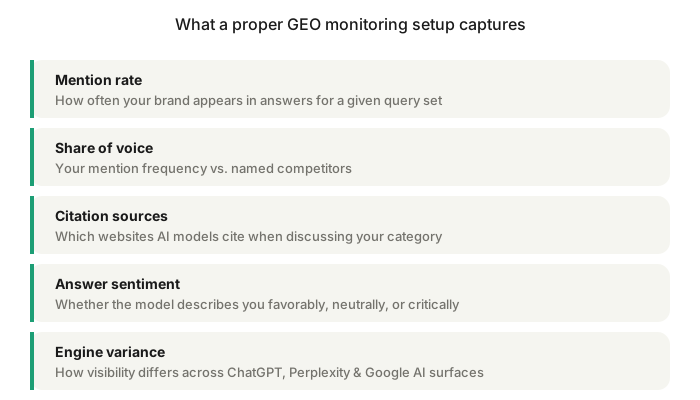
A proper GEO monitoring setup captures:
- Mention rate — how often your brand appears in answers for a given query set
- Share of voice — your mention frequency vs. named competitors
- Citation sources — which websites AI models cite when discussing your category
- Answer sentiment — whether the model describes you favorably, neutrally, or critically
- Engine variance — how your visibility differs across ChatGPT, Perplexity, and Google AI surfaces
SEO platforms are starting to bolt on AI features, but most still orbit around keyword rankings and backlinks. GEO monitoring requires a fundamentally different data model — one built for generative answers from large language models, not blue links.
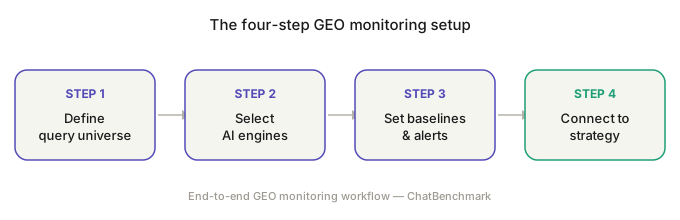
Step 1: Define Your Query Universe
Before you can monitor anything, you need to decide what queries matter. A thin query set will give you thin insights. A sprawling one wastes budget and noise-floods your alerts.
We recommend organizing your query universe into four categories:
| Query Type | Example | What It Reveals |
|---|---|---|
| Branded | ”Is [YourBrand] a good option for X?” | Direct reputation, how AI describes you |
| Category | ”Best tools for [use case]“ | Whether you appear in unaided recommendations |
| Competitor | ”[Competitor] vs alternatives” | Visibility in competitor-intent sessions |
| Use-case | ”How do I solve [specific problem]?” | Topic authority at the point of need |
For most mid-market brands, a strong starting set is 40–80 queries distributed across these four types. Enterprise brands in competitive categories often need 150–400. The temptation to monitor thousands of queries upfront almost always backfires — you get data you can’t act on.
A useful rule of thumb: if you can’t imagine a real buyer typing the query, it doesn’t belong in your monitoring set. AI models aggregate intent across billions of conversations, so long-tail edge cases rarely move your visibility meaningfully compared to the handful of queries that dominate buyer research.
Step 2: Select Which AI Engines to Monitor
The next question is which AI surfaces to cover. The four that matter most in April 2026 are ChatGPT, Google AI Overviews, Google AI Mode, and Perplexity — each representing a distinct slice of AI search behavior.
- ChatGPT drives the largest share of conversational AI traffic globally, with hundreds of millions of weekly active users. It’s where exploratory research and shortlisting happen.
- Google AI Overviews sit at the top of standard Google results, catching users who searched habitually but now receive a generated answer first.
- Google AI Mode is the newer, fully conversational Google surface — closer to ChatGPT in interaction style and increasingly the default for logged-in Google users.
- Perplexity over-indexes on technical, financial, and professional research audiences who value citation-heavy answers.
Monitoring one engine isn’t enough. Our internal benchmarks across monitored brands show that visibility scores can vary by 40–60% between engines for the same query set. A brand that shows up confidently in ChatGPT might be invisible in Perplexity simply because its domain lacks the citation footprint Perplexity’s retrieval layer prioritizes. Academic research on generative engine optimization has documented similar dynamics — specific citation patterns consistently influence how often a source is surfaced in generated answers.
If you’re new to this topic, our practical guide to AI search visibility explains the mechanics of how each engine assembles its answers and why visibility patterns diverge.
Step 3: Set Baselines and Configure Alerts
Monitoring without baselines is just dashboard decoration. Before you can detect meaningful changes, you need to know what “normal” looks like.
We recommend a two-week baseline window at the start of any GEO monitoring program. Run your full query set daily or every other day, and capture:
- Average mention rate per query category
- Share of voice vs. your 3–5 named competitors
- Top 10 most-cited domains in your category
- Sentiment distribution across branded queries
Once the baseline is locked, configure alerts. The most useful alert thresholds we’ve seen in practice:
- Share-of-voice drop of 10 percentage points or more vs. rolling 14-day average
- New competitor entering top 3 in category queries
- Citation source loss — a domain that consistently cited you stops doing so
- Sentiment shift — neutral or positive mentions trending negative
Be deliberate about alert fatigue. GEO data is inherently noisier than keyword rank data because AI model outputs have natural variance. A single-day dip rarely matters; a five-day trend almost always does. We’ve seen teams abandon entire monitoring programs because they configured alerts on raw daily numbers and drowned in false positives within a week.
Step 4: Connect Monitoring Insights to Strategy
Data without a decision loop is waste. The brands that get ROI from GEO monitoring wire their insights into three operational motions:
Content strategy. When a category query pulls in a competitor’s blog post as a citation but not yours, that’s a direct content gap signal. Use citation analysis to prioritize topics, formats, and entities you need to own. Our walkthrough on how to audit your AI search presence shows how to turn citation gaps into a prioritized content roadmap.
PR and earned media. AI models rely heavily on third-party sources. If competitors are consistently described through phrases that trace back to a specific tier-1 publication, you need coverage in that same outlet — not a random guest post farm. GEO monitoring surfaces the exact publications that carry weight in your category.
Competitive response. When a competitor suddenly surges in share of voice, the cause is almost always traceable — a product launch, a Reddit thread going viral, an analyst report landing, or a fresh batch of reviews. Monitoring tells you when to investigate; log analysis tells you why.
For brand-specific tactics, our guides on improving your brand’s ChatGPT visibility and optimizing content for Google AI Overviews go deeper on the levers that most reliably move the needle.
Common Mistakes to Avoid
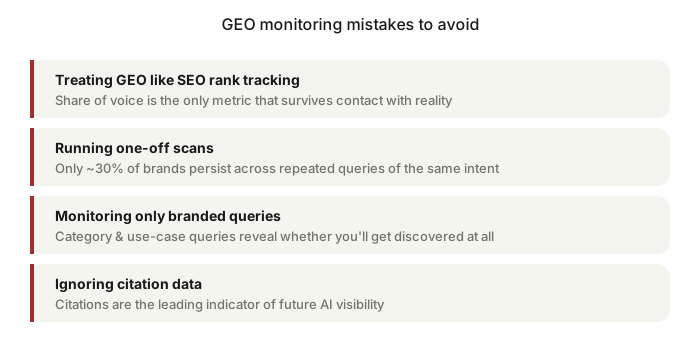
After reviewing dozens of GEO monitoring setups across brands and agencies in early 2026, the same mistakes keep showing up:
- Treating GEO like SEO rank tracking. Position-based thinking doesn’t map to generative answers. Share of voice is the only metric that survives contact with reality.
- Running one-off scans. AI visibility is volatile — only about 30% of brands persist across repeated queries of the same intent. A single scan is a snapshot, not a signal.
- Monitoring only branded queries. Branded queries tell you how AI describes you once someone already knows you exist. Category and use-case queries tell you whether you’ll get discovered in the first place.
- Ignoring citation data. Knowing you were mentioned matters less than knowing which sources shaped that mention. Citations are the leading indicator of future visibility.
How ChatBenchmark Automates This Setup
The steps above describe the anatomy of a GEO monitoring program. The logistics — running hundreds of queries daily across four engines, normalizing outputs, tracking share of voice, flagging citation changes — are what turn this into a full-time job if you do it manually.
ChatBenchmark is purpose-built for this workflow. We track brand mentions, share of voice, and citation sources across ChatGPT, Google AI Overviews, Google AI Mode, and Perplexity on a continuous schedule, benchmark you against named competitors, and surface alerts when visibility patterns shift. Teams typically uncover meaningful visibility gaps within their first week of monitoring.
See how AI sees your brand — try a free scan at chatbenchmark.com and get a baseline view of your current GEO footprint across all four major engines.
Frequently asked questions
What is GEO monitoring?
GEO monitoring is the continuous tracking of how your brand appears in AI-generated answers from engines like ChatGPT, Google AI Overviews, Google AI Mode, and Perplexity. It measures mention frequency, share of voice against competitors, citation sources, and sentiment — not keyword rankings.
How often should I run GEO monitoring scans?
Daily or every other day is the practical standard for most brands. AI answers have stochastic variance, so single-day snapshots are unreliable — you need rolling averages across at least 14 days to detect real trend changes.
Which AI engines should I monitor first?
Start with ChatGPT, Google AI Overviews, Google AI Mode, and Perplexity. These four surfaces cover the vast majority of AI search volume and exhibit enough visibility variance that monitoring only one gives you a dangerously incomplete picture.
How long does it take to set up GEO monitoring?
A useful baseline can be established in two weeks — one week to define queries and configure tracking, one week to collect baseline data across engines. Actionable insights typically emerge within the first 14–21 days of continuous monitoring.
What metrics matter most in GEO monitoring?
Share of voice against named competitors, citation sources, mention sentiment, and engine-to-engine variance are the four metrics that survive contact with reality. Rank-style position metrics don't translate to generative answers.