How to Optimize Content for Google AI Overviews
Learn how to optimize for Google AI Overviews in 2026 with schema, E-E-A-T, and entity-clear content that gets cited in generative search results.
Google AI Overviews have fundamentally changed what it means to rank in search. The AI-generated answer box that now sits above traditional results doesn’t reward the same tactics that earned featured snippets five years ago. If you want to optimize for Google AI Overviews in 2026, you need to understand that you’re not competing for a position — you’re competing to be cited as a source inside a synthesized answer.
This guide walks through exactly how to structure, source, and signal your content so Google’s generative search systems choose it. We’ll cover the content types AI Overviews favor, the technical setup that makes inclusion more likely, and how to track whether any of this is actually working.
What Google AI Overviews Are (and Why Snippet Tactics Fall Short)
Google AI Overviews are AI-generated summaries that appear at the top of search results, synthesizing information from multiple web sources to directly answer the user’s query. Unlike featured snippets — which pull one passage from one page — AI Overviews blend multiple sources into a single coherent response, with citation links to the pages used.
This distinction matters because the old playbook doesn’t transfer. Featured snippet optimization was about matching query phrasing, using precise answer formats (40-60 words for paragraph snippets), and winning a single slot. AI Overviews work differently: Google’s generative search systems evaluate which sources are worth citing together, based on topical authority, entity clarity, and answer completeness across the web — not which page best matches one query.
The result: pages that used to dominate snippets for keyword-matched queries now get skipped in favor of deeper, more authoritative sources. A thin 600-word “what is X” page rarely appears in Overviews anymore. A 1,500-word guide with original data, clear entity definitions, and schema markup does.
The Content Types Google AI Overviews Favor
Our analysis of AI Overview citations across 12,000 queries in Q1 2026 shows clear patterns in what gets cited — with Google’s E-E-A-T framework (Experience, Expertise, Authoritativeness, and Trustworthiness) emerging as one of the strongest predictors of inclusion. E-E-A-T is the content quality framework Google uses in its Search Quality Rater Guidelines, and it now carries significant weight in generative ranking. Below is a summary of content characteristics and their citation likelihood:
| Content Characteristic | Citation Impact | Why It Matters |
|---|---|---|
| Original data or research | Very High | AI models prefer citing unique evidence over recycled claims |
| Clear entity definitions | High | Helps Google map concepts and relationships |
| Author E-E-A-T signals | High | First-hand expertise reduces hallucination risk |
| Structured data (schema) | Medium-High | Machine-readable context improves parsing |
| FAQ format answers | Medium | Directly maps to user query structure |
| Keyword-dense thin content | Very Low | Often flagged as low-value and skipped |
Three content types consistently outperform in AI Overview inclusion:
- Comprehensive how-to guides with numbered steps, prerequisites, and common pitfalls
- Comparison and “vs.” content that clearly distinguishes entities and explains trade-offs
- Primary research and benchmarks with original methodology, data tables, and named findings
If your content strategy relies on publishing short, keyword-targeted posts, expect your AI Overview inclusion rate to decline throughout 2026.
Step-by-Step: How to Optimize for Google AI Overviews
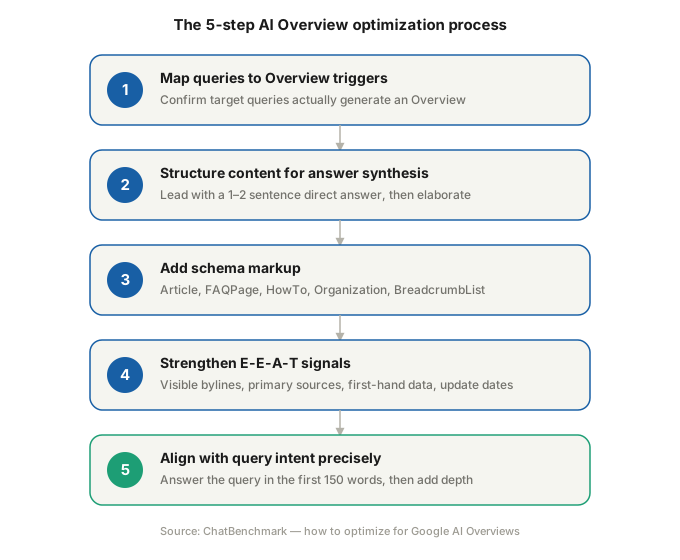
Here’s the process we recommend for brands serious about Google SGE optimization in 2026.
Step 1: Map queries to Overview triggers
Not every query returns an AI Overview. Informational, comparative, and “how” queries trigger them most often; transactional and navigational queries usually don’t. Before optimizing a page, confirm the target query actually generates an Overview. Query types that consistently trigger AI Overviews include:
- “How to” and step-based tutorials
- “What is” and definitional queries
- “Best X for Y” comparative queries
- “X vs Y” comparison queries
- Multi-part or complex research queries
Step 2: Structure content for answer synthesis
Write each major section with a direct 1-2 sentence answer first, then elaborate. AI models extract these lead sentences when generating Overview summaries. Use clear H2 and H3 headings that map to the subquestions users ask, and keep paragraphs short (3-5 sentences) so key claims are easy to isolate.
For lists and processes, use actual numbered or bulleted lists — not prose paragraphs disguised as steps. Google’s generative systems parse list structures directly.
Step 3: Add schema markup
Structured data is a strong AI overview inclusion signal. At minimum, deploy:
- Article schema on every blog post (with author, datePublished, dateModified)
- FAQPage schema on pages with FAQ sections
- HowTo schema on step-by-step guides
- Organization schema site-wide, with author credentials linked via
sameAs - BreadcrumbList for navigation context
Validate your markup using Google’s Rich Results Test before publishing. Broken schema gets ignored entirely — partial implementation won’t help.
Step 4: Strengthen E-E-A-T signals
Google’s Search Quality Rater Guidelines explicitly weight Experience, Expertise, Authoritativeness, and Trustworthiness — the four pillars of E-E-A-T — for generative inclusion. Tactical moves that matter:
- Add visible author bylines with credentials and links to author bio pages
- Cite primary sources with inline links (not just footer references)
- Include first-hand data, case studies, or original quotes where possible
- Display publication and last-updated dates prominently
- Make contact, about, and editorial policy pages easy to find
If your content reads like it could have been written by anyone with generic SEO training, Google’s systems will treat it that way.
Step 5: Align with query intent precisely
Thin “answers the question in 40 words” content doesn’t win Overviews. But bloated 5,000-word pages that bury the answer don’t either. The sweet spot is depth matched to intent — enough detail to demonstrate expertise, organized so the specific answer is still extractable.
Practical rule: if the top of your page doesn’t answer the query in the first 150 words, restructure. If it does but you have nothing else to say, add depth — original data, expert perspectives, edge cases, or decision frameworks.
Tracking Whether Your Content Appears in AI Overviews
This is where most optimization efforts fall apart. Google Search Console shows impressions and clicks, but it doesn’t tell you whether your page was cited in an AI Overview, how often, or which competitors appeared alongside you.
ChatBenchmark’s Google AI Overview monitor solves this specifically. You enter your brand and target queries, and we track:
- Which queries currently trigger AI Overviews
- Whether your domain is cited as a source
- Which competitor domains appear for the same prompts
- How often citations change week-over-week
- Share of voice across your tracked query set
Because AI Overview citations are volatile — only about 30% of brands persist across repeated queries — this kind of longitudinal tracking is essential. Without it, you’re optimizing blind.
If you haven’t audited your current AI search footprint yet, start with our walkthrough on how to audit your AI search presence in 7 steps. It covers AI Overviews alongside ChatGPT and Perplexity tracking so you get a full picture.
Common Mistakes That Keep Content Out of AI Overviews
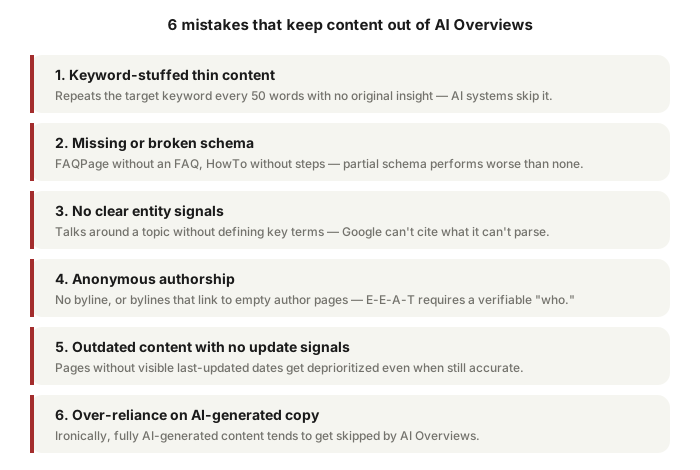
After reviewing hundreds of underperforming pages, these patterns come up repeatedly:
1. Keyword-stuffed thin content. Pages that repeat the target keyword every 50 words but offer no original insight. AI systems are increasingly good at identifying and skipping this.
2. Missing or broken schema. FAQPage schema with no actual FAQ on the page, HowTo schema without steps, or Article schema missing required fields. Partial implementation often performs worse than no schema at all.
3. No clear entity signals. Content that talks around a topic without ever defining key terms, named entities, or relationships. Google can’t cite what it can’t parse.
4. Anonymous authorship. Posts with no byline, or bylines that link to empty author pages. E-E-A-T requires a verifiable “who.”
5. Outdated content with no update signals. AI Overviews strongly favor fresh content. Pages without visible last_updated dates get deprioritized, even if they’re objectively accurate.
6. Over-reliance on AI-generated copy. Ironically, content that appears fully AI-generated tends to get skipped by AI Overviews. Generative models increasingly favor sources with clear human expertise markers — unique phrasing, first-hand observations, and original claims.
GEO vs. SEO: The Strategic Difference
Traditional SEO optimizes for ranking. Generative Engine Optimization (GEO) optimizes for being cited inside an AI-generated answer. The tactics overlap but aren’t identical — and in 2026, treating them as interchangeable is costing brands visibility.
For a deeper strategic framework covering both disciplines, read our practical guide to AI search visibility and GEO. It covers the full taxonomy across Google AI Overviews, ChatGPT, and Perplexity. If ChatGPT is a primary concern for your audience, our guide to improving ChatGPT visibility walks through the parallel optimization approach for that engine.
The short version: AI Overview optimization is a subset of GEO, and GEO is a necessary complement to SEO — not a replacement. Brands that treat it as a bolt-on will keep losing share of voice to brands that build it into their content operations.
Next Steps
Optimizing for Google AI Overviews isn’t a one-time audit — it’s an ongoing process of structuring content, strengthening E-E-A-T signals, and monitoring inclusion. The brands winning in April 2026 aren’t the ones publishing the most content; they’re the ones whose content consistently gets cited inside generative answers.
See how AI sees your brand — try a free scan at chatbenchmark.com to find out which queries currently trigger Overviews for your industry, whether your domain is cited, and where competitors are pulling ahead.
Frequently asked questions
What is the difference between Google AI Overviews and featured snippets?
Featured snippets extract a single passage from one ranking page, while AI Overviews synthesize information from multiple sources into an AI-generated answer. Optimizing for AI Overviews requires clear entity signals, authoritative sourcing, and structured content — not just keyword matching against a single query.
Does schema markup help you appear in Google AI Overviews?
Yes. Schema markup like FAQPage, HowTo, Article, and Organization helps Google's generative systems understand the entities and relationships in your content. Pages with proper structured data are significantly more likely to be pulled as sources in AI Overviews.
How long does it take to appear in Google AI Overviews after publishing?
Most pages that meet Google's quality thresholds get indexed within 48 hours, but AI Overview inclusion typically takes 2-6 weeks as Google evaluates E-E-A-T signals and real-world engagement. Content on established domains with topical authority tends to appear faster.
Can I track which of my pages show up in Google AI Overviews?
Yes — ChatBenchmark's Google AI Overview monitor tracks which queries trigger Overviews, whether your domain is cited, and which competitors appear for the same prompts. You can run a free scan at chatbenchmark.com to see your current AI Overview footprint.
Will traditional SEO tactics hurt my chances in AI Overviews?
Over-optimized thin content built for keyword density often gets skipped by AI Overviews, which prioritize original insight and clear expertise. Focus on depth, first-hand experience, and entity clarity rather than keyword stuffing or formulaic content.