How to Improve Your Brand's ChatGPT Visibility
Learn how to improve ChatGPT brand visibility with proven tactics: build authority, structure content for AI citation, and benchmark against competitors.
If your customers are asking ChatGPT for recommendations in your category and your brand isn’t in the answer, you’re invisible. The goal of this guide is simple: give you a practical, tested playbook to improve ChatGPT brand visibility — not through hacks, but through the same signals the model itself rewards. We’ll walk through how ChatGPT actually selects brands, four concrete steps you can take this month, and the common mistakes that keep otherwise strong brands out of the conversation.
This is a how-to, not a theory piece. By the end, you’ll know exactly what to measure, what to build, and where to look first.
How ChatGPT Decides Which Brands to Mention
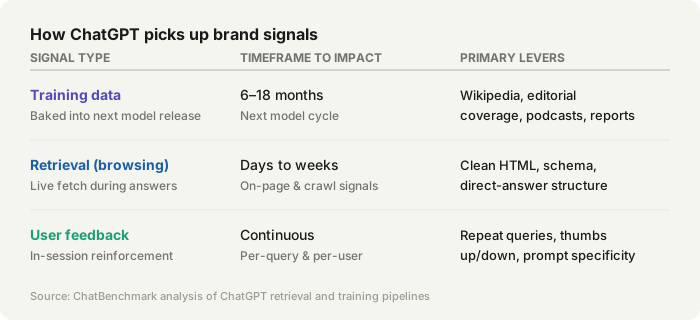
ChatGPT pulls brand mentions from two distinct layers: training data (what the model learned during pre-training and fine-tuning) and retrieval (what it fetches live when browsing is enabled). Understanding this split is the foundation of every tactic below.
Training-data signals include entity strength across the open web — Wikipedia pages, editorial coverage in major publications, authoritative industry blogs, structured data, and mentions in large public corpora. These signals are “baked in” until the next model release and shift slowly. OpenAI’s public documentation on how ChatGPT and its language models are developed describes a pipeline that leans heavily on publicly available, high-quality sources — which is why random social posts and ad copy rarely move the needle.
Retrieval signals are faster-moving. When ChatGPT browses, it behaves more like a search system — reading pages, extracting facts, and citing sources. Here, on-page structure, freshness, and crawlability dominate.
| Signal Type | Timeframe to Impact | Primary Levers |
|---|---|---|
| Training data | 6–18 months (next model) | Wikipedia, editorial coverage, podcast transcripts, industry reports |
| Retrieval (browsing) | Days to weeks | Clean HTML, direct-answer structure, schema, page speed |
| User feedback | Continuous | Repeat queries, thumbs-up/down, user prompt specificity |
The practical implication: you need to work both layers in parallel. Ignore retrieval and you won’t show up this quarter. Ignore training signals and you won’t show up next year.
Step 1: Build Authoritative Third-Party Coverage
Your own website is necessary but not sufficient. ChatGPT treats self-referential marketing copy with skepticism — the strongest signal of brand authority is what other trusted sites say about you, not what you say about yourself.
Focus on three coverage types:
- Industry editorial. Trade publications, Reuters/Bloomberg for larger brands, vertical-specific outlets. A single feature in an authoritative outlet often outweighs 50 guest posts on low-quality blogs.
- Listicles and “best of” roundups. When a journalist writes “Top 10 [your category] in 2026,” that list enters the training data of future models. Pitch to be included — with substance, not just a press release.
- Wikipedia and structured references. A well-sourced Wikipedia entry is one of the highest-value signals you can earn. Don’t fake it — support the entry with genuine third-party citations.
One non-obvious tactic: podcasts get transcribed, and those transcripts are indexed. A well-placed podcast appearance can move visibility surprisingly fast because the transcripts feed both retrieval and future training sets.
Step 2: Structure Content for Citation
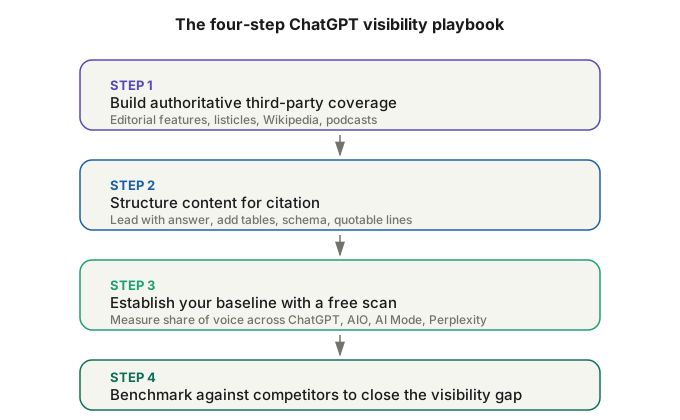
Direct answer: ChatGPT cites content that is easy to extract. If your page buries the answer in paragraph seven, you lose to the site that states it in sentence one.
Apply these formatting principles to every page you want cited:
- Lead with the answer. Start each section with a 1–2 sentence definitive statement, then elaborate. This mirrors the “direct answer” pattern AI models are trained to extract.
- Use unambiguous entity definitions. When you mention a product, concept, or category, define it crisply on first reference.
- Include tables. Comparison and specification tables are retrieval-gold — they give models clean, structured data.
- Add schema markup. FAQ, Product, Organization, and Article schema help crawlers parse your content reliably. Google’s introduction to structured data covers the essentials that apply across AI search systems.
- Write quotable sentences. AI models lift verbatim sentences into answers. One sharp, citable line per section beats three paragraphs of hedged prose.
These are the same principles behind the ChatGPT SEO optimization tactics driving visibility for top performers in April 2026 — and they work because they match how the underlying retrieval systems actually parse the web. For the full framework, see our practical guide to GEO.
Step 3: Establish Your Baseline With a Free ChatBenchmark Brand Scan
You cannot improve what you cannot measure, and traditional SEO tools are blind to generative search. Before you change anything, you need an honest baseline: how often does ChatGPT currently mention your brand for the queries your buyers are asking?
A free ChatBenchmark brand scan takes minutes and surfaces:
- Share of voice across ChatGPT, Google AI Overviews, Google AI Mode, and Perplexity for your core category queries
- Which competitors are getting mentioned instead of you
- Which sources AI models are citing when answering questions in your space
- Prompt-level gaps — specific queries where you’re invisible but should be dominant
This baseline is what turns the rest of the work from guesswork into measurable progress. Without it, you’re optimizing in the dark.
See how AI sees your brand — try a free scan at chatbenchmark.com.
Step 4: Benchmark Against Competitors to Close the Visibility Gap
Direct answer: the fastest way to get mentioned in ChatGPT is to reverse-engineer why your competitors already are.
Take the top three brands that appear for your core queries and analyze:
- Which publications cover them? Pitch the same outlets with a differentiated angle.
- What structured pages do they rank? Look for comparison pages, glossaries, benchmark reports.
- What sources does ChatGPT cite for them? Those are the domains you need backlinks and mentions on.
- What content gaps exist? If no one has written the definitive comparison piece for your category, that’s your opportunity.
The goal isn’t to copy — it’s to identify the pattern of authority the model has already learned to trust, and then build a more defensible version of that authority for your brand.
According to research from Gartner on generative AI adoption, buyers are increasingly starting their purchase journeys inside generative interfaces rather than traditional search. Brands that benchmark early are compounding their visibility advantage while competitors are still debating whether GEO matters.
Common Mistakes That Sabotage ChatGPT Visibility
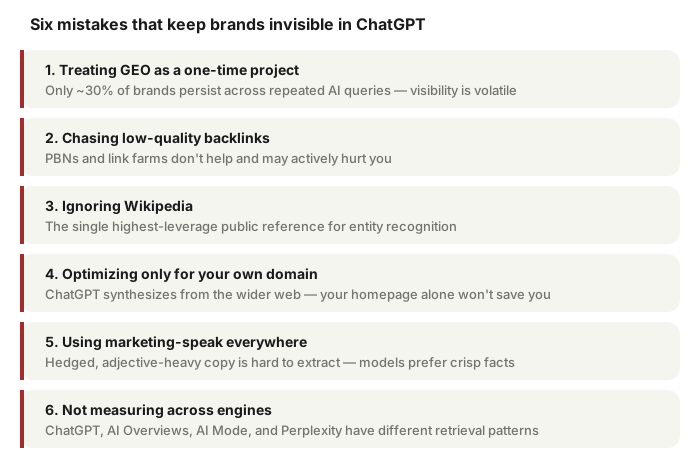
Even experienced marketing teams make these errors when trying to increase ChatGPT brand mentions:
- Treating GEO as a one-time project. Only about 30% of brands persist across repeated AI queries — visibility is volatile, and you need ongoing monitoring, not a single audit.
- Chasing low-quality backlinks. PBNs, link farms, and scraped aggregators don’t help and may actively hurt you. Authority signals must come from genuinely trusted sources.
- Ignoring Wikipedia. It’s the single highest-leverage public reference for entity recognition. Not having a well-sourced entry when competitors do is a structural disadvantage.
- Optimizing only for your own domain. ChatGPT synthesizes from the wider web. If the web is silent about you, your homepage won’t save you.
- Using marketing-speak everywhere. Hedged, adjective-heavy copy is hard to extract. Models prefer crisp factual statements.
- Not measuring across engines. ChatGPT, Google AI Overviews, AI Mode, and Perplexity have different retrieval patterns. Optimizing for one doesn’t guarantee wins on others.
Measuring Progress Over Time
Direct answer: measure share of voice weekly, source citations monthly, and competitor gaps quarterly.
Share of voice is the metric that matters most. Unlike “ranking position” — which is largely meaningless in generative search — share of voice tells you what percentage of relevant AI answers actually mention your brand. A move from 8% to 22% share of voice typically correlates with a 2–4x lift in qualified AI-referred traffic, consistent with the broader finding that AI recommendations convert at multiples of traditional organic search.
Track these three KPIs in a simple dashboard:
| KPI | What It Measures | Cadence |
|---|---|---|
| Brand share of voice | % of category prompts where your brand appears | Weekly |
| Citation sources | Which domains AI models cite when answering about you | Monthly |
| Competitor gap | Prompts where competitors appear but you don’t | Quarterly |
For the full measurement framework, including prompt selection, sampling cadence, and reporting templates, see our complete GEO playbook.
The Bottom Line
To improve ChatGPT brand visibility in 2026, you need to think like a publisher, a PR team, and an SEO specialist simultaneously. Earn authoritative third-party coverage. Structure your own content so models can cite it cleanly. Measure rigorously across engines. Close the gap against competitors who are already winning.
None of this is magic — it’s the disciplined application of signals the models themselves are trained to reward.
The first step is knowing where you stand today. See how AI sees your brand — try a free scan at chatbenchmark.com and get a clear, prompt-level picture of your ChatGPT visibility within minutes. From there, the playbook above gives you everything you need to close the gap.
Frequently asked questions
How does ChatGPT decide which brands to mention?
ChatGPT mentions brands based on two signals: patterns learned during model training from authoritative public content, and real-time retrieval from the web when browsing is active. Brands that appear frequently in trusted third-party sources, structured data, and high-quality editorial coverage have a meaningful advantage.
Can I pay to appear in ChatGPT responses?
No. As of April 2026, ChatGPT does not sell placement in its generative responses, and attempts to manipulate outputs through prompt injection or spam are actively filtered. The only reliable path is to earn visibility through authoritative content and strong brand signals across the open web.
How long does it take to improve ChatGPT brand visibility?
Retrieval-based mentions (when ChatGPT browses in real time) can shift within days of publishing new authoritative coverage. Training-based mentions update only with new model releases, so durable gains typically compound over 3–6 months of consistent work.
What content format does ChatGPT prefer when citing sources?
ChatGPT favors content with clear direct answers, structured headings, comparison tables, and explicit entity definitions. Pages that load fast, have clean HTML, and provide unambiguous factual statements are far more likely to be cited than dense marketing copy.
How do I know if my brand is mentioned in ChatGPT?
You need monitoring tools designed for generative search — traditional rank trackers don't work. A free ChatBenchmark brand scan shows how often your brand appears across ChatGPT, Google AI Overviews, AI Mode, and Perplexity for the queries that matter to your category.