If your brand isn’t named inside AI-generated answers, you’re invisible to a growing share of your buyers. A traditional SEO audit won’t catch that — it was designed for a world of blue links, not synthesized paragraphs. To audit AI search presence properly, you need a different playbook, and this guide walks through the seven steps we use at ChatBenchmark to map where brands stand across ChatGPT, Perplexity, Google AI Overviews, and AI Mode.
By the end, you’ll have a repeatable AI visibility audit checklist, a competitive baseline, and a clear list of the content and citation gaps you need to close before Q3 2026.
Why a Traditional SEO Audit Misses 93% of AI Search Activity
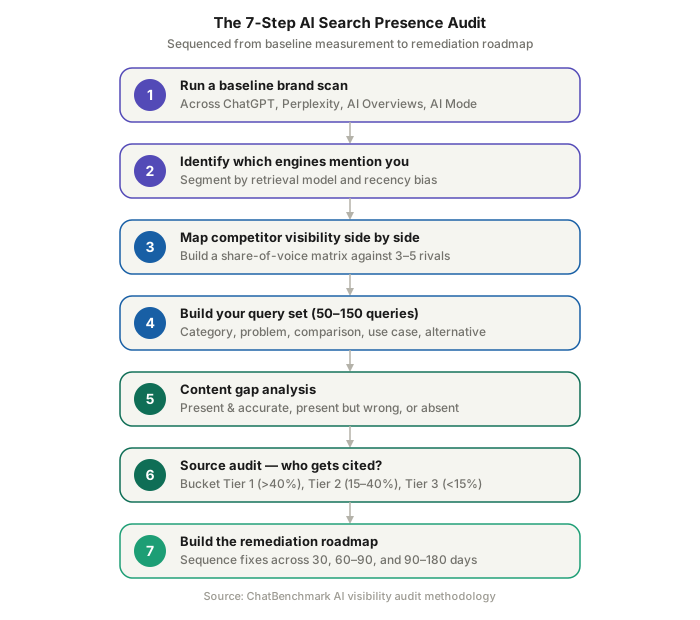
Roughly 93% of AI search sessions end without a click to any source website. That single statistic, consistent with findings from both Pew Research and industry analysts tracking large language model traffic, explains why legacy audits are now incomplete. Your rankings in Google’s blue links can be pristine while ChatGPT confidently recommends a competitor — and your analytics dashboard will show nothing unusual.
A traditional SEO audit evaluates crawlability, backlinks, and keyword rankings. A GEO audit asks a different set of questions:
- When users ask category-defining questions, is our brand named in the answer?
- Which sources does the AI cite — and are we one of them?
- How does our share of voice compare to direct competitors?
- Is the sentiment attached to our brand accurate and flattering?
If you want the strategic foundation before diving into tactics, our practical guide to GEO covers why generative engine optimization behaves differently from classical SEO. With that context in place, here’s the seven-step audit.
Step 1: Run a Baseline Brand Scan Across Major AI Engines
Start by measuring where you stand today across ChatGPT, Perplexity, Google AI Overviews, and Google AI Mode. Without a baseline, you can’t prove improvement — or diagnose regressions when they happen.
A baseline scan should capture:
- Whether your brand is mentioned at all for your top 20-50 category queries
- The sentiment and accuracy of each mention
- The sources the AI cited alongside your brand
- The position of your brand within the response (first, middle, last, or buried in a list)
You can run this manually — spin up fresh browser sessions, ask each engine the same 50 queries, log the responses in a spreadsheet — or use a dedicated platform. The free brand scan at chatbenchmark.com produces this baseline in a few minutes and saves you the manual logging.
Step 2: Identify Which Engines Mention You (and Which Ignore You)
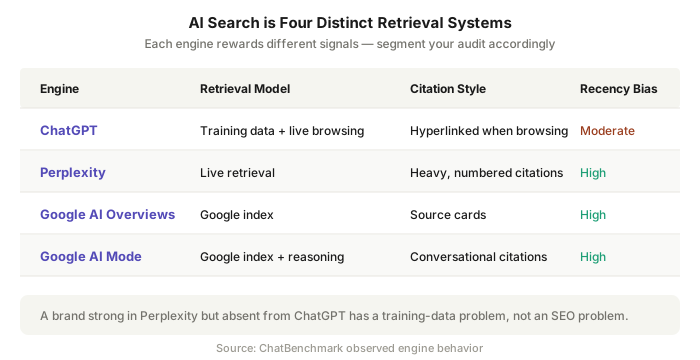
AI engines do not behave identically. We’ve seen brands with 40% visibility in Perplexity register under 5% in ChatGPT because the underlying training data, retrieval partners, and recency windows differ dramatically.
Segment your baseline results by engine to reveal those asymmetries:
| Engine | Retrieval Model | Citation Style | Recency Bias |
|---|---|---|---|
| ChatGPT | Training data + live browsing | Hyperlinked citations when browsing | Moderate — mixes knowledge and web |
| Perplexity | Live retrieval | Heavy, numbered citations | High — prioritizes recent sources |
| Google AI Overviews | Google index | Source cards | High — current indexed content |
| Google AI Mode | Google index + reasoning | Conversational citations | High |
This table tells you where to focus. A brand that’s strong in Perplexity but absent from ChatGPT has a training-data problem. A brand invisible in AI Overviews probably has a Google indexing and authority problem. Don’t treat “AI search” as a single surface — it’s four distinct retrieval systems.
Step 3: Map Competitor Visibility Side by Side
Your visibility only matters in relation to competitors. Pick 3-5 direct competitors and run the same query set against each brand. The output should look like a share-of-voice matrix:
| Brand | ChatGPT SoV | Perplexity SoV | AI Overviews SoV | Combined |
|---|---|---|---|---|
| Your Brand | 18% | 34% | 12% | 21% |
| Competitor A | 41% | 29% | 38% | 36% |
| Competitor B | 22% | 18% | 25% | 22% |
| Competitor C | 8% | 11% | 6% | 8% |
Share of voice — the percentage of category answers in which your brand is named — is a more honest metric than “ranking position” for AI answers, because AI responses aren’t ranked lists. They’re synthesized paragraphs where a brand is either present or absent.
For deeper tactics on improving share of voice in a single engine, our guide to improving brand ChatGPT visibility breaks down the specific levers that move this number.
Step 4: Build Your Query Set — What Actually Triggers Your Category?
The question you’re really answering: what does your ideal customer type into ChatGPT the moment they’re ready to buy?
Most brands audit the wrong queries. They test branded searches (“Is Acme Corp good?”) where they’re obviously mentioned, and miss the unbranded category queries where the actual buying decisions happen.
A proper AI search audit query set includes:
- Category queries (“best CRM for small SaaS teams”)
- Problem queries (“how to reduce customer churn”)
- Comparison queries (“HubSpot vs Salesforce for startups”)
- Use case queries (“CRM for a 20-person B2B company”)
- Alternative queries (“alternatives to Salesforce”)
Aim for 50-150 queries per audit. Pull them from your sales team’s call notes, support ticket subjects, Reddit threads in your category, and keyword tools. According to research from Gartner on generative AI adoption, buyers increasingly phrase queries conversationally, so include natural-language variants alongside keyword-style phrasings.
Step 5: Content Gap Analysis — Are You in the Answer?
For each query in your set, three outcomes are possible:
- Present and accurate — your brand is mentioned correctly (the goal state)
- Present but inaccurate — your brand is mentioned with wrong pricing, features, or positioning
- Absent — a competitor is named instead, or no brand is named at all
The third category is where your content gap analysis begins. If buyers in your category ask “what’s the best X for Y” and you’re not in the answer, two things are typically missing:
- Content on your own site that explicitly addresses that query in the language buyers use
- Third-party coverage (reviews, comparisons, industry roundups) that AI models can retrieve and cite
Prioritize queries by commercial intent first, search volume second. A query that gets 200 searches a month but drives 30% of deals matters more than a 10,000-search query that brings only curious readers.
Step 6: Source Audit — Which Sites Does AI Cite for Your Category?
When AI engines generate an answer about your category, whose websites are they citing? This is arguably the most important — and most overlooked — step in an AI visibility audit.
For each query, log the cited sources. After 50-100 queries, patterns emerge: certain publications, forums, comparison sites, and vendor pages appear repeatedly. These are your category’s authoritative sources in the eyes of AI models.
Bucket them:
- Tier 1 — cited in >40% of category answers (must-have presence)
- Tier 2 — cited in 15-40% (high-leverage)
- Tier 3 — cited in <15% but relevant
If you’re not cited on Tier 1 sources, you have a PR, partnership, or content-contribution problem, not a website problem. Resolving it requires getting featured, reviewed, or mentioned by those specific properties — something a traditional SEO audit would never surface.
Step 7: Build the Remediation Roadmap
The final step converts findings into an action plan. A good GEO audit guide doesn’t just expose problems — it sequences fixes by impact and effort.
Structure the roadmap in three horizons:
- 30 days: Fix inaccurate mentions (update your own site’s canonical pages so AI retrieval corrects itself, submit corrections to Wikipedia and review sites)
- 60-90 days: Publish the missing category content — comparison pages, buyer guides, and use-case pages targeted at the unbranded queries where you’re absent
- 90-180 days: Earn placements on Tier 1 sources through partnerships, expert contributions, data studies, and digital PR
Set measurable targets: “increase ChatGPT share of voice from 18% to 30% by Q3” is actionable; “improve AI visibility” is not.
The Most Common Audit Mistakes — and How to Avoid Them
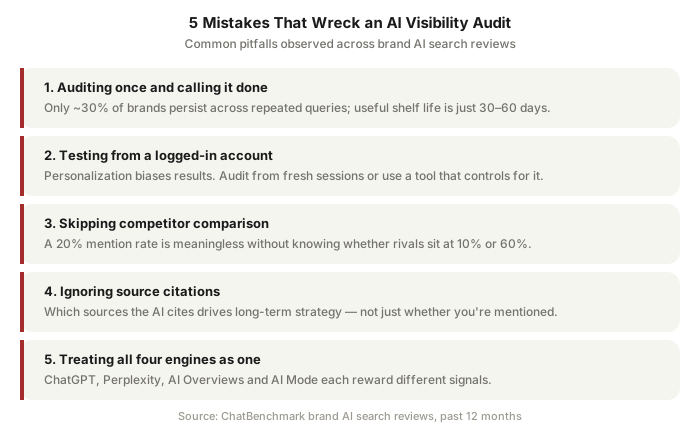
In the brand AI search reviews we’ve run over the past year, the same mistakes repeat:
- Auditing once and calling it done. AI model outputs drift. Only about 30% of brands persist across repeated queries in the same session, and results shift week to week. A one-time audit has a useful shelf life of 30-60 days.
- Testing from a logged-in account. Your personal ChatGPT history biases results. Always audit from fresh sessions or use a tool that controls for personalization.
- Skipping competitor comparison. Knowing you’re mentioned in 20% of answers is meaningless without knowing whether competitors are at 10% or 60%.
- Ignoring source citations. Brands obsess over whether they’re mentioned and forget to ask which sources are being cited. The second question drives the long-term strategy.
- Treating all four engines as one. ChatGPT, Perplexity, and Google’s AI surfaces reward different signals. A tactic that works on one can be irrelevant on another.
How ChatBenchmark Automates This Workflow
Done manually, this seven-step audit takes a skilled analyst roughly 8-12 hours per brand — and it’s stale within a month. ChatBenchmark automates the entire loop: running your query set across ChatGPT, Google AI Overviews, Google AI Mode, and Perplexity continuously, tracking share of voice against competitors, logging cited sources, and alerting you when visibility drops.
If you want to go deeper on the methodology behind these metrics, our practical guide to AI search visibility explains the scoring approach in detail. For a hands-on tactical next step, the ChatGPT visibility playbook covers the specific interventions that move the numbers once your audit exposes the gaps.
See how AI sees your brand — try a free scan at chatbenchmark.com and turn this seven-step audit into a live dashboard your team can act on this quarter.